






AI in Insurance: Transforming the Industry Through Intelligent Automation

 Updated on Apr 28, 2025
In recent years, AI in insurance has become one of the most far-reaching technology trends in the insurance industry. No longer just a theory or experiment, artificial intelligence is gradually changing the way insurance companies operate, from risk assessment, claim processing to personalizing customer experience. Applying AI helps insurance companies optimize processes, improve operational efficiency and create superior value for both businesses and customers. In the article below, let’s explore with STS Software what AI in insurance industry is, the challenges and future trends of the insurance industry when using AI.
The Current State of AI in the Insurance Industry
The insurance industry is witnessing a dramatic shift in the adoption of artificial intelligence in the insurance industry into core operations. According to the Conning 2024 survey, 77% of senior executives said their organizations are at some stage of AI adoption, up 16 percentage points from the previous year.
Another report from McKinsey found that 70% of insurers plan to deploy predictive AI models within the next two years, reflecting the growing use of AI in the insurance industry to improve efficiency and competitiveness.
In the health insurance sector in particular, about 37% of professionals said their organizations have deployed generative AI tools in production, indicating a progression from the experimental stage to real-world applications.
In addition, according to a report from SAS, 89% of insurance companies plan to invest in generative AI by 2025, with 92% of them already having a dedicated budget for this technology.
The widespread adoption of AI in the insurance industry not only helps automate processes but also enhances fraud detection, improves customer experience and optimizes risk management. With the current pace of development, artificial intelligence in the insurance industry is becoming a key factor in the innovation and growth strategies of insurance companies globally.
Key Applications of AI Across the Insurance Value Chain
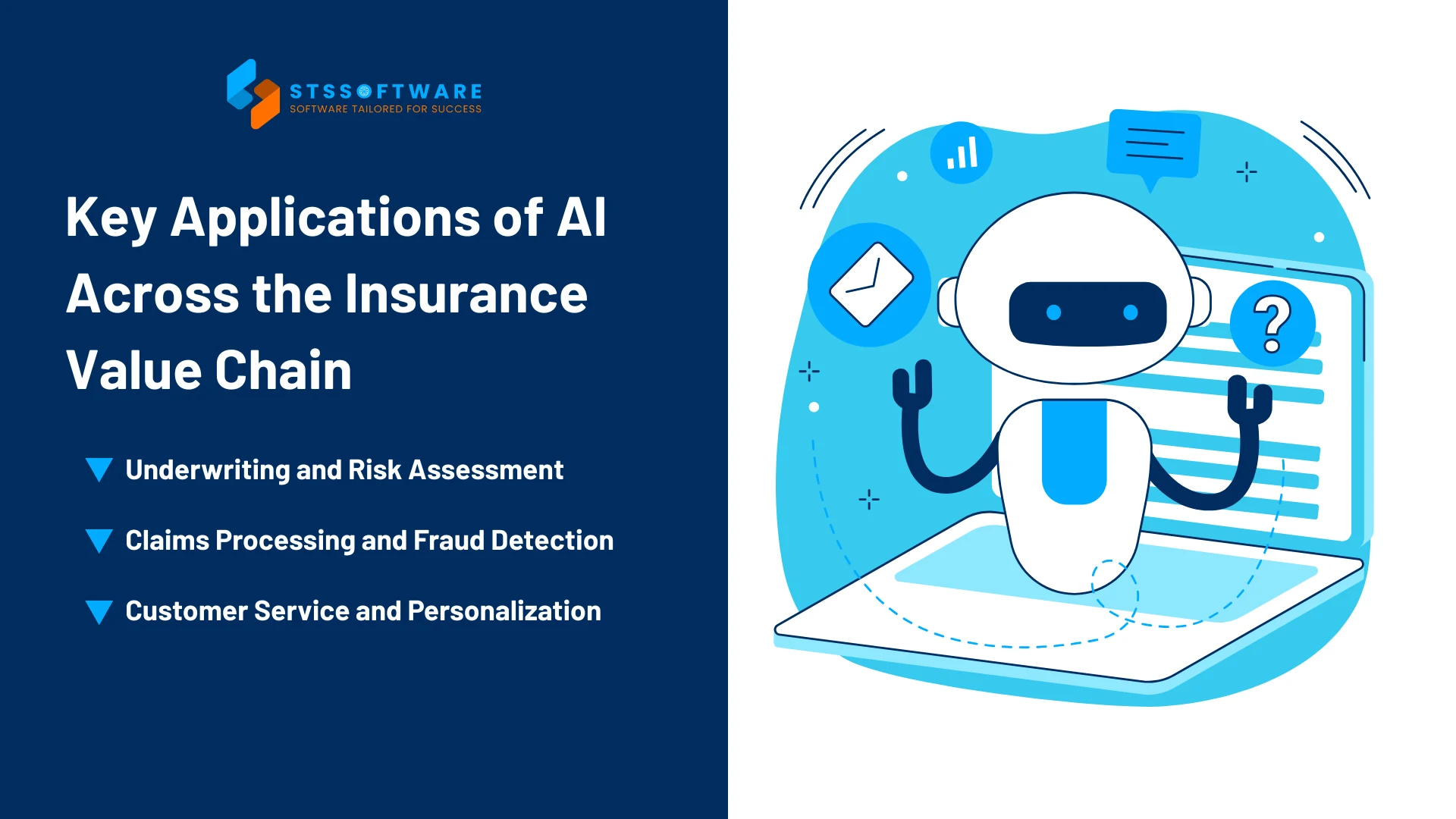
The application of AI in insurance is constantly expanding, not only limited to a few individual stages but also spread across the entire value chain of the insurance industry. From customer attraction, risk assessment, claim processing to personalized care, AI insurance is contributing to reshaping the way insurance companies operate, helping to improve efficiency, optimize costs and improve customer experience. Below are the outstanding applications of artificial intelligence and insurance in each specific stage:
Underwriting and Risk Assessment
In the field of artificial intelligence in insurance, one of the most important advances is the ability to improve the accuracy of pricing and risk assessment. AI algorithms can analyze millions of historical data on customer behavior, personal information, medical history, credit history and environment to make decisions faster and more accurately than traditional manual methods.
According to a 2025 BizTech Magazine technical analysis, AI reduced the average pricing decision time from 3–5 days to 12.4 minutes for standard contracts, while maintaining a 99.3% accuracy rate in risk assessment.
A McKinsey report found that implementing insurance artificial intelligence can significantly reduce processing times, often leading to improved operational efficiency and customer satisfaction. (source from Ancileo report)
Claims Processing and Fraud Detection
AI in insurance is creating a major breakthrough in claims processing. Thanks to the ability to automate processes, AI helps significantly reduce processing time, increase resolution speed and improve customer satisfaction. At the same time, artificial intelligence insurance also detects the very latent frauds that human beings would be unable to detect.
According to the Insurance Information Institute, nearly 10% of all claims filed are fraudulent and can cause billions of dollars in damage each year. AI helps analyze unusual behaviors, compare them with historical data models to provide early warnings, and support more effective fraud prevention.
Customer Service and Personalization
The combination of insurance AI and supporting technologies such as chatbots, conversational AI, and customer data analysis is completely changing the user experience. Instead of waiting hours to meet a consultant, customers can now receive instant feedback from virtual assistants 24/7, get suitable insurance packages suggested, and receive personalized care.
A report by Accenture shows that more than 80% of consumers are willing to use AI and insurance services if it helps them save time and have a more convenient experience.
Artificial intelligence and insurance are no longer distant tomorrows but must now be regarded as inseparable in the operations and developmental strategy of the modern insurance company. From internal process efficiency through to enhanced customer experience, AI shapes the future of the insurance sector to be far beyond what it is today: smarter, more accurate, and most personalized than ever before.
Implementation Challenges and Considerations for Insurance Companies
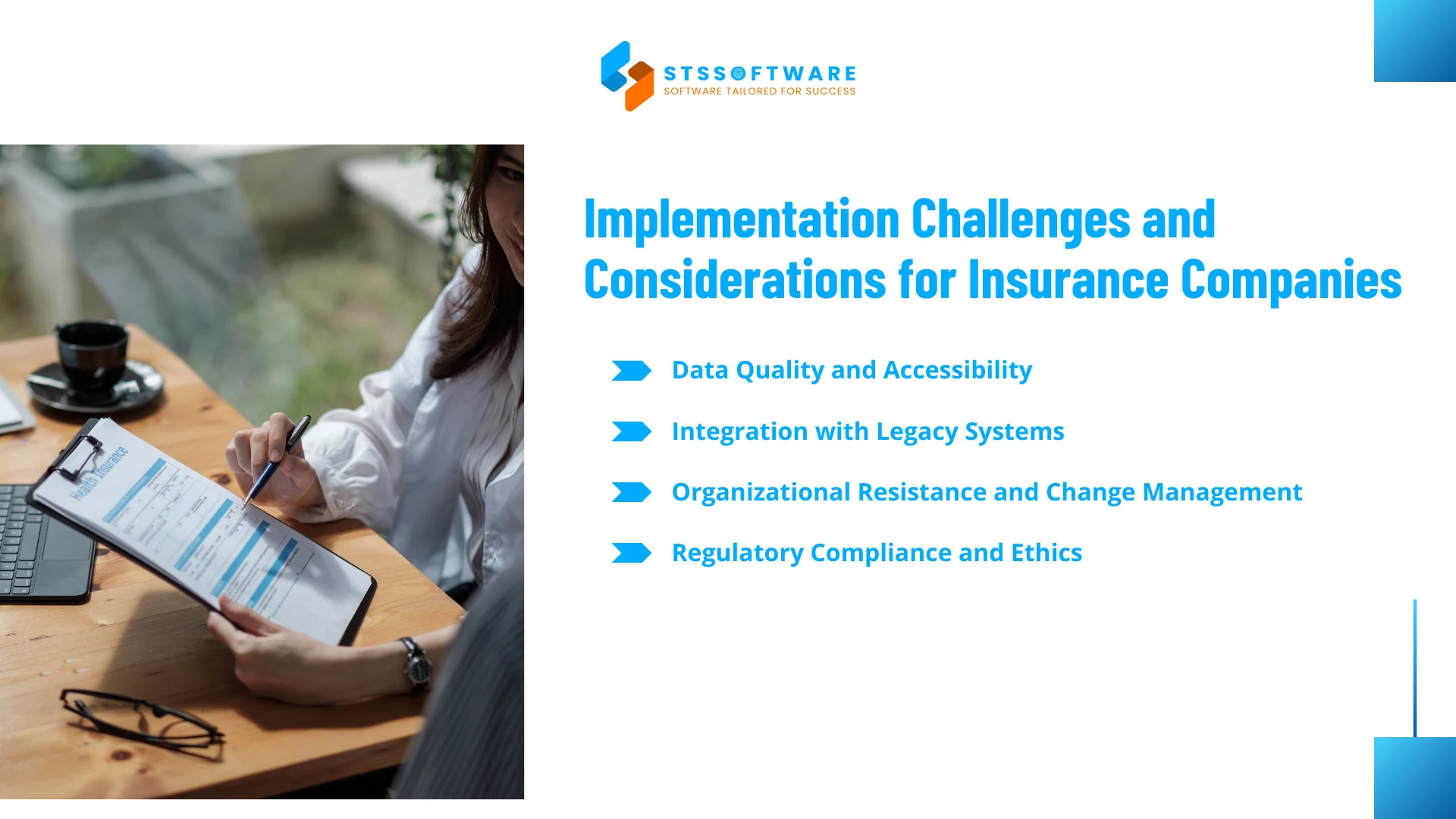
Using the artificial intelligence techniques in the insurance sector has yet many ways of reforming and improving operational efficiency. Adoption of the AI technology within the insurance sector has many significant barriers such as data quality, integration with legacy systems, and organization resistance.
Data Quality and Accessibility
One of these barriers to AI implementation in the insurance sector is data quality and availability. The majority of insurers are still using legacy systems with patchy and incompatible data making it harder for the institution to train and deploy effective AI models. According to Baker Tilly, one of the major challenges to innovation as concerns the insurance sector is poor and inconsistent data quality.
Integration with Legacy Systems
This means that in most cases still, insurers are chained to old IT systems that do not permit the promises of advanced AI technologies. The re-engineering of such systems into AI-ready capability takes a lot of infrastructure upgrades along with development of solutions that can work with that. According to research from ValueMomentum, 57% of insurance decision makers said integrating legacy systems is a significant issue in AI implementation.
Organizational Resistance and Change Management
Implementing artificial intelligence in the insurance industry is not only a technical issue, but also involves changing organizational culture. Employees may be concerned about AI replacing their jobs, leading to resistance and reduced implementation efficiency. According to a report from Five Sigma Labs, change management is one of the main challenges when implementing AI in claims processing technology.
Regulatory Compliance and Ethics
With the rest of the industries, insurances are under intense regulatory and ethical scrutiny. The proposed AI implementation in the insurance industry should be in line with regulations regarding data security and privacy, as well as avoiding biases in the decision-making process. The UK Financial Conduct Authority (FCA) warns that it might make some people “uninsurable” or some customer groups discriminate against them.
For this, insurance companies must also put in place good data management systems, update their IT infrastructure, promote a mind-set of innovation, and most importantly, compliance with the regulations in place. Application of AI in the insurance sector, thus, will produce better prospects in not only availing the fullest potential of AI by the insurance industry, but is also expected to gain full customer trust and satisfaction.
Future Trends: What’s Next for AI in Insurance
In the next 3–5 years, AI in the insurance industry will continue to grow strongly with the emergence of a series of advanced technologies and breakthrough innovations, promising to reshape the entire way the insurance industry operates. Not only stopping at digitizing or automating basic processes, artificial intelligence and insurance will transform into a smart, proactive ecosystem that can predict customer needs and market risks.
One of the notable trends is the integration of AI with Internet of Things (IoT) technology. Smart sensors from cars, wearable devices or smart homes will provide real-time data, helping insurance companies make more flexible pricing decisions that are closer to actual behavior. For example, with car insurance, premiums can change based on the way users drive, instead of being based on traditional demographic factors.
In addition, the development of new-generation AI such as Generative AI, advanced conversational AI and deep learning models will help personalize services at a higher level, from marketing, customer care to designing product packages according to each individual need.
Besides that, companies in the AI in insurance industry will also promote research and application of AI in risk simulation and forecasting the impact of climate change – a factor that increasingly affects the property and life insurance sector.
However, along with the potential, the insurance industry will also face new challenges related to data security, AI ethics and legal compliance. Therefore, businesses need to have a strategy to develop artificial intelligence and insurance that is not only technologically effective but also sustainable and transparent.
In short, the future of AI in the insurance industry will not only be about optimizing performance, but also the key to comprehensively innovating business models, creating superior value and building sustainable trust with customers.
Why Choose STS Software as Your Partner for AI in Insurance
With extensive experience in the field of financial technology – insurance, STS Software is the ideal choice for businesses looking for a comprehensive, effective and practical AI in insurance solution. We understand that each insurance organization has specific requirements, from data characteristics, operating systems to business strategies. Therefore, STS Software always accompanies customers in every stage, from strategic consulting, system development to long-term operation optimization and maintenance.
STS Software’s strength lies in its team of experienced technology engineers and insurance experts. Our teams have successfully implemented many artificial intelligence insurance projects for domestic and foreign companies. STS Software’s solutions not only help automate the application appraisal process, detect insurance fraud or improve customer experience, but also ensure compliance with strict requirements on data security and legal regulations.
STS Software focuses on the ability to flexibly integrate with traditional insurance systems, while building an AI architecture that can scale to the enterprise scale. Thanks to that, businesses can easily deploy AI in insurance without encountering obstacles in technology or internal operations.
More than a technology provider, STS Software is a strategic partner, committed to providing optimal artificial intelligence insurance solutions – helping insurance businesses improve productivity, reduce operating costs and create sustainable competitive advantages in a market that is shifting strongly towards digitalization.


Related articles
AI Chatbot Development: An Ultimate Guide
 Bruce
Bruce  05 May 2025
Telemedicine App Development: The Complete Guide for 2025
05 May 2025 
Doctor Appointment App Development: The Complete Guide
05 May 2025 
How AI Image Processing Is Revolutionizing Business Operations in 2025
28 Apr 2025 
Building the Perfect Customer Service Chatbot: A Comprehensive Strategy for Businesses
28 Apr 2025 
Fintech Software Outsourcing: The Ultimate Guide to Choosing the Right Partner
28 Apr 2025 
How to Build a Payment App: A Comprehensive Guide for Businesses
28 Apr 2025 
Transforming Business with Computer Vision AI
25 Apr 2025 
Insurance Mobile App Development: A Complete Guide for Industry Leaders
25 Apr 2025 


