







 Updated on May 05, 2025
Telemedicine app development is changing healthcare for good. These apps bring virtual doctor visits, health tracking, and medical care right to your fingertips, no matter where you are. The COVID-19 pandemic put telehealth in the spotlight, but its staying power is real.
The global telemedicine market grew from USD 135.71 billion in 2024 to USD 160.13 billion in 2025, and is projected to reach USD 709.69 billion by 2034, with a CAGR of 17.99%. This growth reflects not just a trend but a fundamental shift in how healthcare is delivered. From small clinics to major hospitals, telehealth app development is reshaping the industry with smart tech, like AI and wearables, with patient-focused solutions.
STS Software is proud to lead the charge, building telemedicine apps that make a difference. With our deep expertise in secure, HIPAA-compliant platforms and seamless integration with systems like electronic health records (EHRs), we’ve helped healthcare providers deliver care that’s both innovative and reliable.
In this guide, we’ll break down everything you need to know about telemedicine application development in 2025. This will help you create an app that stands out in the US market.
Understanding Telemedicine Applications
Telemedicine apps are bridging gaps between patients and providers. These apps come in various forms, each tailored to specific needs and use cases, which makes telemedicine software development a dynamic field.
- Video consultation platforms enable real-time, face-to-face interactions for diagnoses, treatment plans, and follow-ups. For example, a primary care doctor can assess a patient’s symptoms via secure video and prescribe medication without an in-person visit.
- Remote patient monitoring (RPM) uses connected devices like smartwatches or glucometers to track vital signs, ideal for managing chronic conditions like diabetes or heart disease.
- Store-and-forward telemedicine allows providers to share medical data, like X-rays or skin images. This is critical in radiology, where specialists review scans remotely, or dermatology, where photos guide diagnoses.
- Mobile health (mHealth) solutions include apps for wellness, such as fitness trackers or meditation tools, complementing telehealth by promoting proactive health management.
- Specialized telehealth solutions, like telepsychiatry for mental health or teledentistry for oral care, address niche needs with tailored platforms.
The benefits of telehealth apps are transformative.
- Patients gain easier access to care, especially in rural areas, which helps save time and travel costs while boosting engagement.
- Providers see improved efficiency, reaching more patients and managing chronic diseases better, with flexible schedules enhancing work-life balance.
- Healthcare organizations cut costs, improve outcomes, reduce hospital readmission rates and unlock revenue through virtual visits.
Essential Features for a Modern Telemedicine App
Building a custom telemedicine app in 2025 means delivering a smooth, secure, and user-friendly experience that meets the needs of patients, providers, and healthcare organizations. A successful telemedicine mobile app development project hinges on integrating core and advanced features.
1. Core Functionalities in Telemedicine App Development
Video Conferencing Capabilities
Video conferencing is the backbone of any telemedicine app, which enables real-time doctor-patient interactions. High-definition (HD) video and stable connections provide clear visuals and uninterrupted calls, especially for diagnosing conditions requiring visual assessment, like rashes or mobility issues.
End-to-end encryption is critical to protect patient privacy while complying with HIPAA regulations. Features like screen sharing allow providers to review charts or explain diagnoses, while session recording (with patient consent) supports documentation.
A strong telemedicine platform must perform well even in low-bandwidth areas to serve rural users, using adaptive bitrate streaming to keep video quality. A simple, user-friendly interface with easy call joining and audio/video controls makes it accessible for users of all ages.
Secure Messaging
Secure messaging fosters ongoing communication between patients and providers. Compliance with HIPAA requires encrypted channels and audit trails to track message access and modifications. Features like read receipts and time-stamped messages build trust and accountability.
Patients can ask quick questions or share updates, while providers can send follow-up instructions. The UI should be intuitive, with conversations and search functionality to locate past messages. Push notifications ensure timely responses without overwhelming users.
File Sharing
File sharing enables the exchange of medical records, lab results, or images. Supported file types include PDFs, JPEGs, and DICOM for medical imaging, with size limits to optimize performance. Security measures like encryption and access controls prevent unauthorized access, aligning with HIPAA.
A clean interface for uploading, previewing, and downloading files enhances usability. For example, a patient might share a photo of a skin condition, or a provider could upload a radiology report.
Electronic Health Records (EHR) Integration
Smooth EHR integration allows providers access real-time patient data, like medical history or allergies, during consultations. Interoperability standards like FHIR (Fast Healthcare Interoperability Resources) enable smooth data exchange across platforms.
This reduces manual data entry, minimizes errors, and supports informed decision-making. For patients, EHR integration means personalized care without repeating their history. Developers must prioritize secure APIs and regular testing to maintain compatibility with changing EHR systems.
Appointment Scheduling
Online booking simplifies scheduling, letting patients choose slots based on provider availability. Features like automated reminders via email or SMS reduce no-shows, while calendar match with tools like Google Calendar or Outlook keeps schedules organized.
Providers benefit from a dashboard to manage appointments and block off personal time. The system should handle time zone differences for patients across the US, with a user-friendly interface to reschedule or cancel appointments effortlessly.
E-Prescriptions
E-prescriptions streamline medication management, allowing providers to send prescriptions directly to pharmacies. Compliance with DEA regulations and state-specific rules is essential, requiring secure authentication (like two-factor authentication) and tamper-proof systems.
Integration with drug databases enables providers to check for interactions or allergies. Patients appreciate the convenience of digital prescriptions, while pharmacies receive accurate, legible orders, reducing errors.
Payment Processing
Secure payment gateways (e.g., Stripe, PayPal) enable patients to pay for consultations or subscriptions within the app. Compliance with PCI-DSS promises financial data security. Features like saved payment methods, transparent billing, and refund options build trust.
Providers benefit from automated invoicing and revenue tracking. The UI should guide users through payments with minimal steps, supporting multiple methods like credit cards or digital wallets.
2. Advanced Features in Telemedicine App Development
AI-Powered Diagnostics
AI enhances telemedicine by providing early support, such as analyzing symptoms or medical images. For example, it can review a patient’s reported symptoms and suggest possible conditions, so healthcare providers prioritize care more effectively.
In dermatology, AI-powered image recognition can flag potential skin cancer from photos, speeding up referrals. These tools improve efficiency but require careful validation to maintain accuracy and compliance with FDA regulations for medical devices. Patients value faster insights, while providers gain decision-making support.
IoT Integration for Remote Monitoring
IoT integration connects devices like blood glucose monitors, heart rate trackers, or smart inhalers to the app, with real-time data collection for chronic disease management or post-acute care.
For example, a wearable can track a patient’s heart rate and alert providers to irregularities. Data security is important, so it requires encryption and secure APIs to integrate with EHRs. This feature reduces hospital readmissions and encourages patients to manage their health proactively.
Analytics and Reporting
Analytics provide insights into patient outcomes and operational efficiency. Providers can track metrics like consultation frequency or treatment adherence, while administrators monitor app usage or revenue trends.
Dashboards with visual charts make data actionable for organizations to optimize care delivery. For example, analytics might reveal high demand for telepsychiatry, which prompts resource allocation. Data privacy compliance keeps patient information protected.
Multi-Platform Synchronization
A consistent experience across web, mobile, and smart devices is crucial. Patients might book appointments on a phone but join calls via a laptop, so real-time syncing of data like messages or schedules is essential. Responsive design delivers functionality on various screen sizes, while offline capabilities allow limited access during connectivity issues.
3. UI/UX Considerations for Medical Applications
An outstanding UI/UX builds trust and engagement.
- Accessibility maintains compliance with WCAG standards, offering features like screen reader support or high-contrast modes for visually impaired users.
- Clear navigation uses intuitive menus and minimal clicks to access features. This is vital for older patients or those less tech-savvy.
- Trust-building design includes professional branding, transparent privacy policies, and visible security certifications like HIPAA compliance badges.
- Fast load times and error-free performance prevent frustration, while onboarding tutorials guide first-time users.
- Regular user testing refines the experience, ensuring the app feels reliable and welcoming.
Telemedicine App Development Process
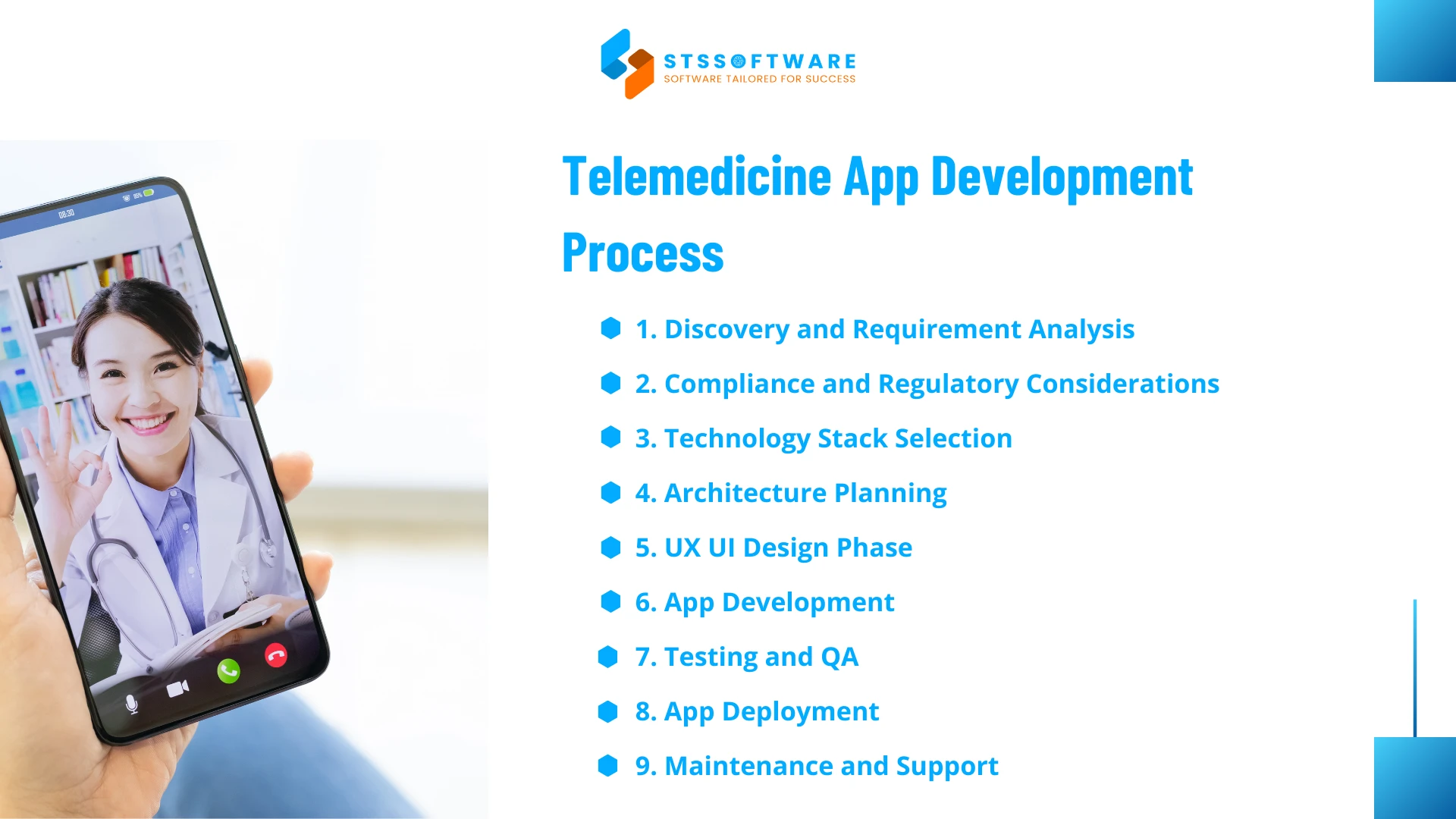
From ideation to post-launch support, telemedicine app development involves multiple phases, each critical to keep compliance, functionality, and patient satisfaction. Below, we outline the comprehensive process, also emphasize the expertise of telemedicine app developers and best practices.
1. Discovery and Requirement Analysis
The foundation of successful telemedicine application software development lies in thorough discovery and requirement analysis. This phase involves engaging stakeholders (such as healthcare providers, patients, administrators, and IT teams) through interviews and workshops to understand their needs, pain points, and goals.
Detailed documentation, including user stories, functional requirements, and technical specifications, guarantees alignment. Telehealth app developers map out features like video conferencing or e-prescriptions, define user roles, and identify regulatory constraints.
This step prevents scope creep and sets a clear roadmap, saving time and costs for later. At STS Software, we prioritize collaborative discovery to tailor solutions for the US healthcare ecosystem.
2. Compliance and Regulatory Considerations
In the US, HIPAA (Health Insurance Portability and Accountability Act) mandates strict protection of patient data, which requires encryption, access controls, and audit trails. Globally, GDPR (General Data Protection Regulation) applies if serving EU patients, which emphasizes consent and data minimization.
Other regulations, like the FDA’s oversight of AI diagnostics or state-specific telehealth laws, add complexity. Compliance is ongoing, not a one-time task. Regular audits and updates keep alignment with evolving standards.
Legal consultation is critical to navigate nuances such as HIPAA’s business associate agreements or GDPR’s data breach reporting timelines. Developers must embed compliance into every phase to avoid costly penalties and build trust.
3. Technology Stack Selection
Choosing the right technology stack is also essential. For backend development, Node.js or Python (Django/Flask) offers strong APIs and scalability, while databases like PostgreSQL ensure secure data storage. Frontend frameworks like React Native or Flutter support cross-platform apps, also balance performance and development speed.
For video conferencing, WebRTC provides low-latency, encrypted communication. Security tools like OAuth 2.0 and JWT handle authentication. Cloud platforms like AWS or Azure offer HIPAA-compliant hosting. The stack must support FHIR for EHR integration and scale to handle peak user loads, such as during flu season.
4. Architecture Planning
A well-designed telemedicine platform uses microservices architecture to scale features like messaging or scheduling independently. API gateways manage secure data exchange, and tools like Docker and Kubernetes make deployment more flexible.
Security is critical, end-to-end encryption and role-based access help protect patient data. Scalability is supported through load balancing to handle peak usage smoothly. For long-term maintainability, developers use modular code and clear documentation.
Top telemedicine app developers also comply with HIPAA and integrate EHR smoothly. This helps build systems that can support millions of users reliably, especially for US healthcare providers.
5. UX UI Design Phase
The UI/UX of a telemedicine app must be intuitive, accessible, and user-friendly for a wide range of users, from tech-savvy patients to busy clinicians. Designers use wireframes and prototypes to map out key workflows, such as booking appointments or joining video calls.
Usability testing with real users helps identify and fix pain points, ensuring that even older users can easily navigate the app. To broaden accessibility, features like high-contrast modes and screen reader support (aligned with WCAG standards) are essential.
Trust is built through clear privacy notices, professional branding, and a smooth user experience. By using an iterative design process with continuous feedback, the app becomes more seamless, reliable, and appealing to users.
6. App Development
Choosing between native and cross-platform development impacts performance, security, and maintainability.
- Native development (Swift for iOS, Kotlin for Android) delivers superior performance and access to device-specific features, like camera optimization for video calls. It’s ideal for complex apps requiring high security and speed but increases development time and cost.
- Cross-platform development (React Native, Flutter) enables a single codebase for iOS and Android, which reduces costs and speeds up delivery. Modern frameworks like Flutter offer near-native performance, suitable for most telemedicine apps. Security remains robust with proper encryption, but cross-platform may limit advanced device integrations.
For US healthcare, telemedicine app developers often choose cross-platform for faster market entry and reserve native for specialized needs like IoT monitoring.
7. Testing and QA
Rigorous testing makes sure that a telemedicine app is functional, secure, and compliant.
- Functional testing verifies features work as intended.
- Security testing, including penetration testing and vulnerability scans, safeguards against data breaches.
- Performance testing ensures the app handles high user loads without lag.
- Usability testing confirms intuitive navigation for diverse users.
- Compliance testing validates adherence to HIPAA, GDPR, and FDA standards, with mock audits to simulate regulatory scrutiny.
8. Deployment
Deployment models vary based on organizational needs.
- Cloud-based deployment (AWS, Azure) offers scalability, HIPAA-compliant storage, and cost efficiency, ideal for startups or large providers serving millions.
- On-premise deployment provides greater control over data, preferred by hospitals with strict security policies but requires significant infrastructure investment.
- Hybrid models balance flexibility and control.
- CI/ CI/CD pipelines provide seamless updates and rollback capabilities to minimize downtime.
- Staged rollouts, starting with a pilot group, catch issues early.
9. Post-Launch Support and Maintenance
Post-launch support plays a crucial role in the long-term success of telemedicine apps. Regular updates introduce new features and keep compatibility with changing EHR systems. Security patches are released promptly to fix vulnerabilities and maintain HIPAA compliance.
Reliable technical support helps resolve user issues quickly. Performance monitoring tools detect crashes or slowdowns early, allowing for proactive fixes. Continuous user feedback guides improvements, such as simplifying navigation or enhancing usability.
To ensure consistent performance, telemedicine app vendors often provide service-level agreements (SLAs) that guarantee high uptime and fast response times, which are critical for healthcare providers and patients.
Telemedicine App Development Costs
Building a custom telemedicine app in 2025 is a strategic investment for healthcare providers, but understanding the cost is crucial for budgeting and planning. Costs vary widely based on features, complexity, and development approach.
This section breaks down the factors influencing costs, provides a realistic expense breakdown, compares in-house versus outsourced development, and offers strategies to optimize budgets while highlighting the return on investment (ROI).
1. Factors Affecting Development Costs
Several variables influence the telemedicine app development cost.
Feature complexity significantly impacts pricing. Basic apps with video conferencing and messaging are less expensive than those with advanced features like AI-powered diagnostics or IoT remote monitoring.
EHR integration complexity, especially with systems like Epic or Cerner, increases costs due to custom APIs and FHIR compliance.
The number of supported platforms (iOS, Android, web) affects development time; cross-platform frameworks like Flutter reduce costs compared to native apps.
AI implementation level, from simple chatbots to image analysis, requires specialized expertise and raises the expenses.
Compliance requirements, such as HIPAA or FDA regulations, demand legal consultations and security measures.
Team location also matters. US-based telemedicine app developers charge more expensive than offshore teams.
Finally, post-launch support, including updates and server costs, adds to the total.
2. Breakdown of Expenses
A typical telemedicine app costs $50,000-$250,000, depending on scope. Below is a breakdown of expenses across phases, with percentage ranges and estimated costs for a mid-complexity app like video calls, EHR integration, secure messaging.
- Design (10-15%, $5,000~$25,000): UI/UX design and prototyping provide an intuitive, accessible interface. This includes wireframes, user testing with patients and providers, and WCAG-compliant designs for accessibility. Costs rise with custom branding or extensive usability testing.
- Development (50-60%, $25,000~$120,000): Frontend development (React Native, Flutter) creates the user interface, while backend (Node.js, Python) handles data and APIs. API integration for EHRs, payment gateways, or video (WebRTC) is a major cost factor. Cross-platform development lowers costs compared to native.
- Testing (15-20%, $7,500~$40,000): QA engineers perform functional, security, performance, and compliance testing. Tools like Selenium automate functional tests, while penetration testing keeps HIPAA compliance. Compliance testing for FDA-regulated features, like AI diagnostics, adds costs.
- Compliance (5-10%, $2,500~$20,000): Legal consultations for HIPAA, GDPR, or state telehealth laws and security audits to validate encryption and access controls are essential. Ongoing audits for evolving regulations increase costs.
- Maintenance (10-15%, $5,000~$30,000/year): Server costs (AWS, Azure), security patches, feature updates, and technical support maintain long-term reliability. Costs scale with user base and feature additions.
3. Cost Comparison: In-House vs. Outsourced Development
In-house development offers control and deep domain knowledge but is costly. Hiring US-based developers, designers, and QA engineers, plus benefits and infrastructure, can exceed $500,000 for a year-long project. It’s ideal for large organizations with ongoing needs but slows progress due to recruitment and training.
Outsourced development to custom telemedicine app development company like STS Software is often more cost-effective ($50,000~$250,000 total). These firms bring healthcare expertise, established workflows, and faster delivery (6-12 months vs. 12-18 months in-house).
Outsourcing reduces overhead but requires clear communication to align on goals. For US healthcare providers, outsourcing to US-based firms ensures regulatory familiarity, while offshore teams have lower costs but may need extra oversight for HIPAA compliance.
4. Ways to Optimize Development Budget
To manage telemedicine app development cost, consider these strategies:
- Start with an MVP: Launch a minimal viable product with core features (video calls, messaging, scheduling) to test the market and gather feedback. An MVP costs $30,000~$80,000, saving 50-70% compared to a full app.
- Prioritize features: Focus on high-impact features like EHR integration and defer advanced ones to later phases, which spreads costs over time.
- Use cross-platform frameworks: Tools like Flutter reduce development time by 30-40% compared to native apps, and lower costs without sacrificing quality.
- Leverage cloud services: HIPAA-compliant cloud platforms like AWS reduce server setup costs and scale efficiently.
- Partner with experienced developers: Trusted companies like STS Software streamline workflows and avoid costly rework due to inexperience.
5. ROI Considerations for Telemedicine Investments
Investing in a custom telemedicine app has significant returns.
- Increased patient reach connects providers with rural or underserved populations, expanding market share.
- Improved efficiency reduces appointment times, which allows providers to see more patients.
- New revenue streams from virtual consultations and subscription models boost income.
- Reduced costs come from fewer in-person visits and lower readmission rates. Enhanced patient satisfaction and competitive advantage in the US market further amplify ROI. In the long-term, apps can evolve with minimal reinvestment for sustained profitability.
Challenges in Telemedicine App Development and How to Overcome Them
Telemedicine software development is transforming US healthcare, but it comes with significant challenges. Below, we explore key challenges and actionable solutions.
1. Technical Challenges
- Interoperability issues arise when integrating with diverse EHR systems or medical devices, often using outdated protocols.
- Data security is critical, as breaches can expose sensitive patient information.
- Reliable video and audio quality is essential for effective consultations, but network variability, especially in rural areas, poses problems.
Solutions: Adopt FHIR standards for interoperability to streamline data exchange. Use end-to-end encryption and secure APIs to protect data. Implement WebRTC with adaptive bitrate streaming to maintain video quality in low-bandwidth scenarios, and test across network conditions to keep reliability.
2. Regulatory Hurdles
Navigating HIPAA, GDPR, and state-specific telehealth laws is complex, with non-compliance risking hefty fines. HIPAA mandates encryption and audit trails, while GDPR requires explicit consent for EU patients.
Solution: Engage expert legal consultants early to map compliance requirements. Conduct regular audits and train developers on regulations. Use HIPAA-compliant cloud providers like AWS and document compliance processes to demonstrate adherence during audits.
3. User Adoption Barriers
Patients and providers may resist technology due to unfamiliarity or uspicion, particularly older users or those accustomed to in-person care.
Solution: Offer intuitive UI/UX with clear navigation and accessibility features, like large fonts or voice commands. Provide onboarding tutorials, live support, and training sessions for providers. Highlight benefits, like time savings, through marketing to boost adoption.
4. Security Concerns
Cyberattacks targeting patient data are a growing threat, with healthcare breaches costing $10 million on average.
Solution: Implement AES-256 encryption, multi-factor authentication, and role-based access controls. Conduct regular penetration testing and vulnerability scans. Schedule security audits to identify weaknesses and apply patches promptly. Educate users on secure practices, like strong passwords, to reduce risks.
5. Integration with Existing Systems
Legacy EHR systems often lack modern APIs, complicating integration. Misaligned data formats can disrupt workflows.
Solution: Use middleware or custom APIs to bridge legacy systems with modern apps. Adopt FHIR for standardized data exchange. Collaborate with EHR vendors during planning to ensure compatibility. Test integrations rigorously to prevent data errors.
6. Solutions and Best Practices
- Proactive planning: Map technical and regulatory requirements during discovery to avoid costly rework.
- User-centric design: Conduct usability testing with diverse patients and providers to refine interfaces.
- Robust testing: Perform functional, security, and performance tests to catch issues early.
- Partnerships: Work with experienced telemedicine software development firms like STS Software to leverage healthcare expertise.
- Continuous monitoring: Use analytics to track app performance and user feedback for iterative improvements.
Future Trends in Telemedicine App Development
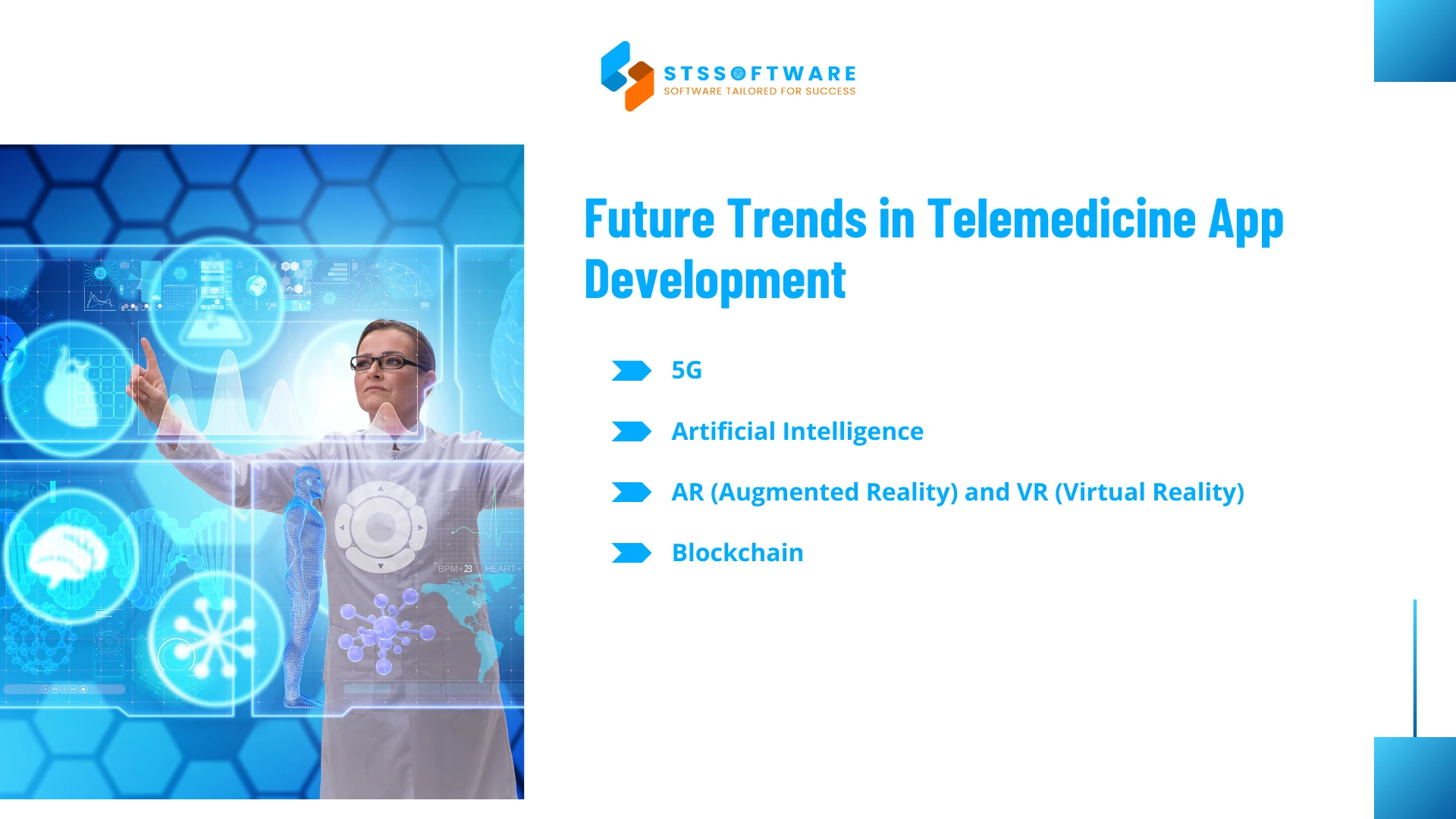
The future of telemedicine app development is bright, with emerging technologies and market growth driving innovation.
1. Emerging Technologies in Telehealth
5G Impact on Telemedicine
5G’s ultra-low latency and high bandwidth enable real-time, high-quality video consultations and remote procedures. It supports seamless transfer of large datasets, such as imaging files, to enhance diagnostics. For example, 5G can reduce latency to under 1ms, critical for real-time monitoring.
AI and Machine Learning Applications
AI powers personalized treatment plans by analyzing patient data, like predicting diabetes complications. Machine learning enables predictive analytics for disease management. Virtual health assistants, like AI chatbots, handle scheduling or symptom triage to improve efficiency.
VR/AR in Telemedicine
Virtual reality (VR) and augmented reality (AR) enhance telehealth through immersive patient education, like 3D heart models for explaining conditions. VR supports remote surgical assistance that guides procedures in real-time. AR enables virtual consultations with overlaid diagnostics to improve patient understanding and engagement.
Blockchain for Medical Data Security
Blockchain provides secure and tamper-proof medical records. It enables secure sharing across providers without intermediaries. This helps enhancing privacy and trust, also streamlining care coordination.
2. Market Predictions and Opportunities
The global telemedicine market is projected to exceed $405.1 billion by 2033, with a (CAGR) of 29.2% from 2023 to 2033.
Remote chronic disease management is a high-growth area, with remote patient monitoring (RPM) reducing costs by 25% for conditions like hypertension, per industry studies.
The pooled acceptability of tele-mental health services among beneficiaries was 71.0% of 3366 search results from BMC Public Health. This highlighted a promising outlook for the integration and adoption of tele-mental health services.
Opportunities abound in rural healthcare expansion and integrating wearables for real-time data. Telemedicine software development focusing on AI, 5G, and niche solutions like teledentistry will capture a significant market share.
Why Choose STS Software as Your Partner for Telemedicine App Development
When it comes to telemedicine app development, STS Software stands out as a trusted, US-based company. With a proven track record in healthcare software, we deliver innovative, compliant, and user-focused telemedicine application solutions tailored to the US market. Here’s why partnering with us delivers your telehealth vision becomes reality.
1. STS Software’s Experience in Healthcare Software Development
STS Software has 13 years of experience building healthcare applications, including electronic health record (EHR) systems, patient engagement portals, and telemedicine platforms.
Our portfolio spans solutions for hospitals, clinics, and startups, using technologies like React Native and Flutter for cross-platform mobile apps, Node.js and Python for scalable backends, and WebRTC for secure video conferencing.
We’ve developed remote patient monitoring (RPM) apps integrated with IoT devices like wearables, as well as practice management software automating scheduling and billing. Our expertise in AI-driven analytics enhances diagnostics and patient insights for future-ready solutions.
2. Previous Telemedicine Projects and Success Stories
Our telehealth app developers have delivered 800+ impactful projects. For a mid-sized US clinic chain, we built a telemedicine app with video consultations and EHR integration. An anonymized case study highlights a rural healthcare provider where our RPM app, integrated with glucose monitors. These successes showcase our ability to drive engagement and efficiency.
3. Technical Expertise Relevant to Telehealth Applications
STS Software’s technical prowess is tailored for telehealth. We excel in EHR integration, using FHIR and HL7 standards to ensure seamless data exchange with systems like Epic and Cerner.
Data security is paramount, with AES-256 encryption, multi-factor authentication, and role-based access controls safeguarding patient information. Our video conferencing solutions leverage WebRTC for HD, low-latency calls, with adaptive streaming for rural connectivity.
We maintain compliance with HIPAA, GDPR, and FDA regulations, and embed audit trails and secure APIs. Our AI and IoT expertise supports advanced features like symptom analysis and real-time vitals monitoring, making us a leader in telemedicine application software development.
4. Development Methodology and Approach
Our client-centric, agile approach provides transparency and collaboration. We begin with stakeholder workshops to define requirements, followed by iterative sprints for rapid prototyping and feedback. Regular check-ins, detailed progress reports, and tools like Jira keep clients informed.
Our team prioritizes usability and conducts user testing with providers and patients to refine interfaces. This flexible methodology adapts to evolving needs, which delivers high-quality apps on time and within budget, while fosters trust through clear communication.
5. Compliance Knowledge and Implementation
Compliance is at the core of our telehealth app development. We have deep expertise in HIPAA, end-to-end encryption, secure data storage, and audit-ready documentation. For international scalability, we align with GDPR and regional standards like PIPEDA.
Our team collaborates with legal consultants to navigate FDA requirements for AI diagnostics and state-specific telehealth laws. We implement Business Associate Agreements (BAAs) and conduct regular security audits. We make sure that your app meets all regulatory benchmarks and builds patient trust.
6. Support and Maintenance Services
Post-launch, STS Software provides comprehensive support to keep your app running smoothly. We offer 24/7 technical assistance, rapid-response ticketing, and SLAs guaranteeing 99.9% uptime.
Regular security patches address vulnerabilities, while feature updates align with new technologies like 5G or AI advancements. Server management on HIPAA-compliant clouds like AWS ensures scalability. Our proactive monitoring detects performance issues early to minimize downtime and keep long-term reliability for US healthcare providers.
Conclusion
STS Software is your ideal partner for telemedicine app development, with healthcare expertise, cutting-edge technology, and consistent compliance to deliver transformative solutions.
Our agile methodology, dedicated support, and proven success empower US healthcare providers to enhance patient care and operational efficiency. Ready to revolutionize healthcare delivery? Schedule a free consultation with STS Software today to explore your vision!


Related articles
Doctor Appointment App Development: The Complete Guide
 Bruce
Bruce  05 May 2025
AI in Insurance: Transforming the Industry Through Intelligent Automation
28 Apr 2025 
Fintech Software Outsourcing: The Ultimate Guide to Choosing the Right Partner
28 Apr 2025 
How to Build a Payment App: A Comprehensive Guide for Businesses
28 Apr 2025 
Insurance Mobile App Development: A Complete Guide for Industry Leaders
25 Apr 2025 
Finance App Development: Strategies, Costs, and Best Practices for Success
23 Apr 2025 
HIPAA Compliant App Development: Comprehensive Guide 2025
05 Feb 2025 


